


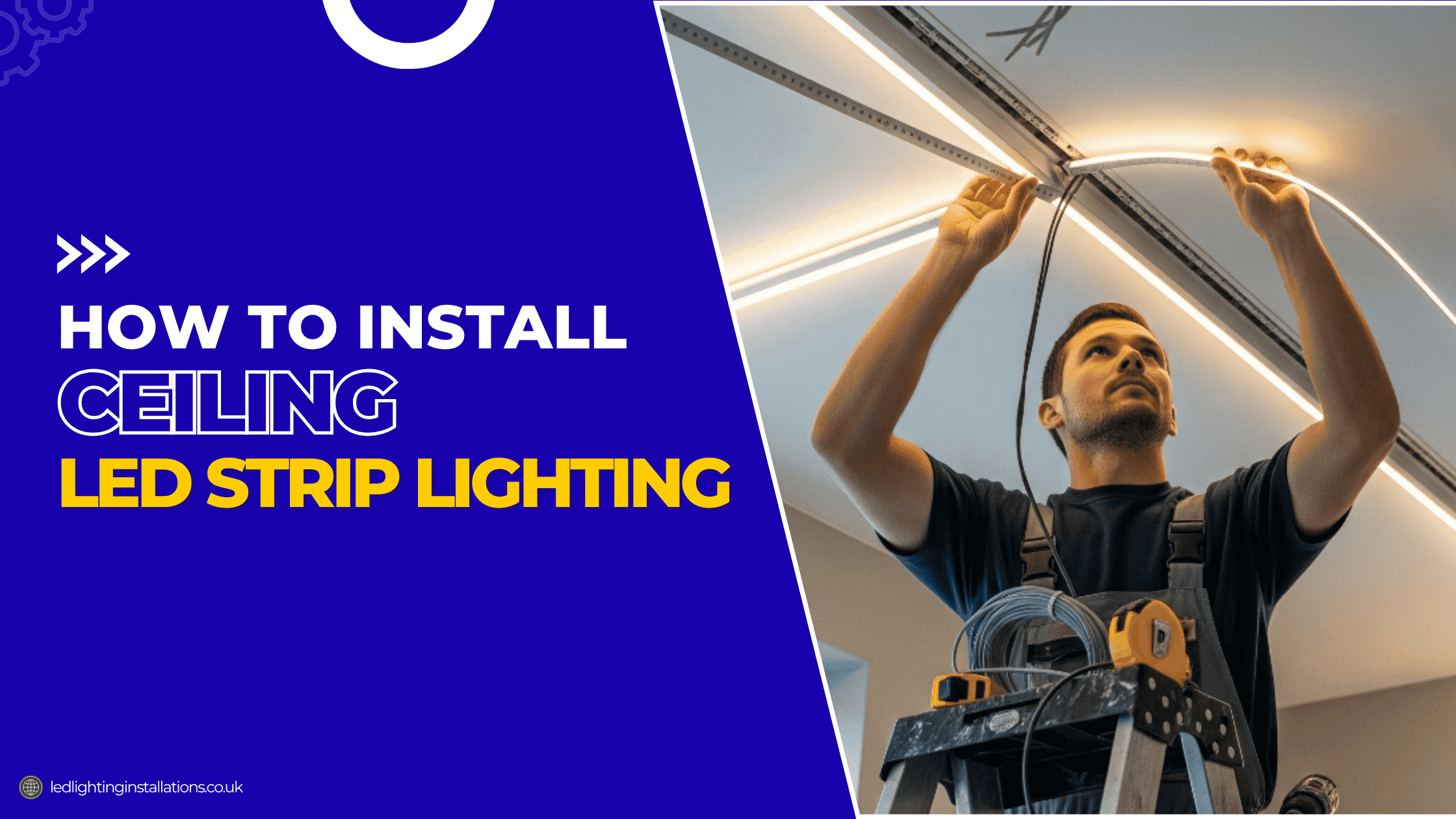
LED strip lights illuminate mesmerisingly and create a dreamy ambience. But how to install LED strip lights on ceiling in London? That’s quite tricky. Whether it’s a drop-down ceiling or a regular one, strip lights showcase their character with a luminous appeal.
All the ceilings don’t have the same pattern or surface. So, when you’re attempting a DIY installation, ensure you know how to install LED strip lights.
If you already have an idea or know how to install LED ceiling lights, that may also help you install LED strip lights. However, we recommend you hire professional LED lighting installers for complex ceiling/circuit conditions.
Trying to navigate how to fit LED strip bulbs on ceilings? In this article, we’ll break it all down to you in detail. Let’s get into it.
How to install LED strip lights on ceiling in London?
Light Emitting Diode (LED) Light installation saves almost 90% of energy consumption. But, unlike other LED lights, the installation of LED strip lights can be challenging. As you know, whatever seems easy is not always easy.
So, before installation, you must consider some significant factors for the best output you could ever imagine. An improper fitting can be heavy for you, exceeding the budget. Let’s delve into the key considerations before installing LED strip lights.
Key factors to consider when installing LED strip lights
LED strip lights come with back adhesives, and installation requirements are complex. Before you install LED strip lights on the ceiling, please consider the factors below and proceed accordingly.
Strip length
Strip lights come as reels, not as single pieces. Measure your ceiling area and calculate the length of strip lights you need. You can buy some extra feet of strip light reel than required.
Brightness level
LED strip light’s brightness level is generally measured by lumens per watt. Lumen number decides whether it’s a cool or warm tone of Light in the ceiling. LED lights with cool brightness contain 4000K lumens per watt; for a warm brightness tone, they contain 2700K-3000K lumens per watt.
Light colour
LED strip lights come with multiple colours. Cool white, Warm White, Pearl White, RGB Colours, etc, are the popular colour tones for LED strip lights in London. Once you learn how to install LED strip lights in London, choose your desired coloured LED strip lights.
Color temperature
Colour temperature changes the ambience. A cool hue of cool white LED strip lights gives a calm, focused vibe. Warm white LED strip lights will provide a warm and cosy vibe. Select cool, warm, or bold tones according to your requirement.
Voltage
Select the voltage for your LED strip lights. Knowing how to install LED strip lights on ceilings alerts you to measure the voltage before installing the Lights. Choose a 5V, 10V, 12V, or 24V LED strip lights. The longer length means more voltage, and more voltage means more brightness.
Power consumption ability
Calculate the power consumption of the LED strip lights according to the length in feet. Know how many watts of power each foot requires. Then calculate the total watts needed according to your LED strip light’s length. Add 20% more watts requirement to the calculation to ensure the safety margin.
Surface
Your ceiling surface can be wood, ceramic, marble, vinyl, metal, cement, etc. Smooth surfaces are perfect for LED strip lights. Rough, harsh, or uneven surfaces are inappropriate for LED strip lights. For these complex surfaces, you can contact professional light installers, like LED Lighting Installations.
Positioning
Decide where you want to locate LED strip lights on your ceiling. After deciding on the positioning pattern, plan how to install LED strip lights on the ceiling smoothly. You must be extra careful about the ceiling corners as well.
Equipment you need to install LED strip lights
Here’s the essential equipment you need to install LED strip lights-
▪️SMD chips.
▪️Connectors.
▪️Scissors(Sharp) & Wire Strippers.
▪️Mounting Clips.
▪️Adhesive Tape.
▪️Measuring Tools.
▪️Screwdriver.
▪️Ladder.
▪️Voltage Tester.
▪️Calculator.
▪️Soldering iron/other Soldering Tools. (If required).
▪️Dimmer (If needed).
▪️Cables (If needed).
These are the basic LED strip installation tools. Apart from that, you may need other tools screws, hooks, controlling remotes, etc.
How to install LED light strips in your ceiling?
If you are searching for instructions on how to install LED strip lights on ceilings or how to install LED strip lights in London, you may get many tutorials. But what you exactly need is the LED strip light installation process according to your room’s ceiling condition.
No tutorial can teach you a condition-based installation process for LED strip lights. Here we’re going to break down the LED strip light installation process for specific types of ceiling conditions. Let’s begin!
Bedroom ceiling LED strip light Installation
A bedroom is the place where you find comfort after a busy, hectic day. You need a cosy, comfortable ambience in your bedroom. Choose warm white or RGB strip lights for the bedroom ceiling.
What’ll you need to install:
▪️Scissors(Sharp).
▪️Wire Strippers.
▪️Adhesive Tape.
▪️Measuring Tools.
▪️Screwdriver.
▪️Ladder.
▪️Voltage Tester.
▪️Connectors.
▪️Calculator.
▪️Soldering iron/ other Soldering Tools. (If required).
▪️Dimmer (If required).
Installation Process:
▪️Select the area where you want to locate the LED strip lights.
▪️Measure the area.
▪️Calculate voltage and power capacity.
▪️Cut off LED light strips from the reel according to your required length.
▪️Peel off the back adhesive.
▪️Use the ladder and start attaching the light strip to the ceiling surface.
▪️Keep fitting in small portions.
▪️For more stability, you can use a soldering iron.
▪️Attach cables to the end edge of the strip.
▪️Plug in the socket.
▪️Turn on and test the lights.
▪️You can check the connection using the voltage tester.
Ceiling LED cove and corner light installation
The ceiling cove or corner is a fantastic place to illuminate. It is tricky, yet it delivers a satisfying, luminous effect in the room and ceiling. Let’s explore how to fit ceiling strips on the cove.
What’ll you need to install:
▪️Wire Strippers.
▪️Adhesive Tape.
▪️Measuring Tools.
▪️Screwdriver.
▪️Ladder.
▪️Scissors(Sharp).
▪️Voltage Tester.
▪️Connectors.
▪️Calculator.
Installation Process:
▪️Measure the cove area.
▪️Cut off the strip light from the reel.
▪️Adjust the watts requirement.
▪️Peel off the back adhesive.
▪️Use the ladder to reach the ceiling.
▪️Fit the strips nicely. At the edges, keep it round instead of folding.
▪️Use a soldering iron to set the light strips.
▪️Keep the edges behind the lip to hide them.
▪️Attach the power supply and test.
▪️Turn on the lights and check if everything’s okay.
Outdoor ceiling LED light installation as strips
Installing the outdoor ceiling LED strip lights is challenging. You’ll need IP68 waterproof LED strip lights for outdoors. Also, mounting clips need to be firmly secured.
What’ll you need to install:
▪️Waterproof outdoor strip light fixtures.
▪️Ladder.
▪️Mounting Clips.
▪️Sharp Scissors.
▪️Wire Strippers.
▪️Adhesive Tape.
▪️Measuring Tools.
▪️Screwdriver.
▪️Voltage Tester.
▪️Connectors.
Installation Process:
▪️Determine the length of strip lights you need for your outdoor ceiling.
▪️Measure wisely and cut off the strip from the reel.
▪️Adjust the power voltage.
▪️Use the ladder.
▪️Attach the lights by peeling the back adhesive.
▪️Mount with mounting clips for stability.
▪️Check with the voltage tester.
▪️Turn on the light to check finally.
LED strip light installation on uneven ceiling surfaces
Uneven surfaces make it pretty hard to attach LED strip lights. However, you can install them while ensuring a long-lasting performance.
What’ll you need to install:
▪️Strip light fixtures.
▪️Adhesive Tape.
▪️Mounting Clips.
▪️Ladder.
▪️Sharp Scissors.
▪️Wire Strippers.
▪️Measuring Tools.
▪️Screwdriver.
▪️Voltage Tester.
▪️Connectors.
Installation Process:
▪️Measure the required length of the LED strip light and take 3-4 inches extra as the surface is uneven.
▪️Cut off the strip as you require.
▪️Adjust the power capacity of the lights.
▪️Peel off the back and start attaching.
▪️Please don’t allow it to fold.
▪️Use a ladder while attaching for better reach.
▪️Fasten slowly and press in the centre of each two strip lights for a smooth finish.
▪️Set the power supply.
▪️Connect the plug to the socket and check if the lights are okay.
Drop down ceiling/false ceiling LED strip light installation
Drop-down ceilings are also known as false ceilings. To give your room a modern texture and layer, illuminating the drop-down ceiling with LED strip lights can be an excellent idea.
What’ll you need to install:
▪️Adhesive Tape.
▪️Measuring Tools.
▪️Scissors(Sharp).
▪️Wire Strippers.
▪️Screwdriver.
▪️Ladder.
▪️Voltage Tester.
▪️Connectors.
▪️Soldering iron/ other Soldering Tools. (If required).
▪️Dimmer (If required).
Installation Process:
▪️Determine the length of the drop-down area vertically and horizontally.
▪️Cut the strip light using sharp scissors.
▪️Adjust the power capacity according to the light voltage.
▪️Peel off the back of the strip lights and fasten them to the ceiling surface.
▪️Press the centre of each of the two strip lights.
▪️Connect to the power supply.
▪️Test the connection with a voltage tester.
▪️Turn on the lights.
How to wire LED strip lights on ceiling?
Wiring LED strip lights on the ceiling is not complicated. Strip LEDs consume less power, so the power supply needs to be transformed from AC to DC. Here’s how to wire LED strip lights:
▪️Calculate the voltage demand of the strip light according to its length.
▪️Ensure the power supply is adjusted to the required demand.
▪️Match the voltage.
▪️Connect the cables with the strip lights and the edge.
▪️Use a DC connector or hardware.
▪️Check the polarity twice.
▪️Plug the cable into the power socket.
▪️Check the connection by turning the lights on.
Can I add New LED ceiling strip lights to the existing switch?
Upgrading to new ceiling LED strip lights or attaching new strips to the existing switch is possible. How to connect LED strips? Well, you can connect the edges to two strips with pin connectors, jumper cords, or soldering. You can expand the branches or length of the LED strip by adding new strip lights.
To add new LED ceiling lights, just attach the new strip edge to the old strip edge. Attach the lights and connect them to the cable if you’re installing entirely new LED ceiling strip lights by removing the old ones from the existing switch.
Ensure proper power supply with a precise calculation. In this case, you just change the lights and lastly attach the end edge of the strip lights with the power cable using the DC connector.
How to maintain ceiling LED strip lights?
Maintenance is the key to making any attachment or item long-lasting. We don’t only show you how to install LED strip lights on ceiling, we also provide tips to maintain the lights.
How should you maintain your ceiling LED strip lights? You can follow the tips below:
▪️Always clean the lights with a soft, dry cloth. Don’t wet the lights.
▪️Check connections regularly.
▪️If any flickering happens, cut off the faulty part only. Don’t cut off the whole strip because of 2-3 lights on the strip.
▪️Before opting for a DIY, ensure you know how to install LED ceiling lights. Also, you should know some basic electrical work.
▪️For complex installations, hire professional LED lighting installers.
How much does it cost to install LED strip lights on a ceiling?
LED strip lights installation on a ceiling expense depends on the length of the strip, the type of the strip, the area of lighting, and the labour cost. Without an exact measurement, estimating how much it will cost is difficult.
There is no fixed amount. Let’s break down an estimated cost:
Material Cost:
Item | Item Cost |
Single Coloured Strip (Cool/warm white/other colour) LED Light | £7-£300 |
RGB Strip LED Light | £70-£500 |
Dimmable Strip Light | £8- £220+ |
Additional Cost:
Material | Cost |
LED Power Adapter | £5-£35 |
LED Dimmer Controller | £8-£25 |
RGB Remote Controller | £14-£28 |
LED Aluminium Anodised Channel Diffuser | £10-£115 |
LED Aluminum Crown Molding Channel Diffuser | £20-£1100 |
Installing LED strip lights DIY can range from £50 to £350.
If you hire a professional, labour cost can be £50-£95 per hour. Professional LED strip light installers typically take 2-3 hours to install the strips effortlessly.
Safety precautions for LED strip light installation in the ceiling
Safety should be the priority when there is some electrical work. You must follow some basic precautions when installing LED strip lights on a ceiling. Let’s discuss in detail:
Determine the power requirement first
Before installing LED strip lights on your ceiling, you must check the length of strips, voltage, and required power supply. The lights will not work correctly if the power supply is low or high. Also, a flickering issue can happen.
Don’t overheat
Overheating can be dangerous and cause fire hazards. High-power LED lights can be overheated. To control that heat, you can mount LED strip lights into aluminium channels or crown mould diffusers. You shouldn’t locate strip lights near curtains or flammable materials.
Follow the UK regulations
You should use a 240V to 24V or 12V transformer that complies with the BS EN standard. Buy the materials that have UKCA or CE marks. Use cables rated for ceiling use. The installation must follow UK wiring and Part P building regulations.
Hire a certified electrician
Even if you are installing DIY LED strip lights, you must hire a professional electrician to maintain the Part P Building Regulations and UK wiring Regulations. A certified and registered electrician follows the legal codes and ensures the fuse protection.
Buy branded products only
Compromising with electrical materials can go wrong. When installing LED strip lights on ceilings, avoid non-brand products. Buy renowned, highly rated, and branded items.
LED strip lights ceiling installation: DIY vs professionals
Do you want a DIY installation for LED strip lights on the ceiling? When to hire professionals? A DIY project can be applied to basic LED strip lighting. But, you need a certified electrician if there are complexities like wiring, circuit setting, or smart feature installation.
Let’s see the pros and cons of DIY installation of LED strip lights vs professionally installing LED strip lights.
DIY installation of LED strip lights
Pros:
▪️Cost-efficient.
▪️Saves the labour cost.
▪️It can be done at a flexible time.
▪️Leftover installation equipment or materials can be used further.
Cons:
▪️There can be a risk of faulty installation, light flickering, overheating, mismatched voltages, etc.
▪️Fire hazards or short circuits may happen due to a lack of safety checks.
▪️Highly efficient tools are not always available for a personal or single use.
▪️According to UK safety standards and wiring regulations, some electrical work must be done under a certified, registered electrician to meet Part P building regulations.
Professional installation of LED strip lights
Pros:
▪️Professional electricians take a short time to install LED strip lights efficiently.
▪️They follow UK safety standards and UK wiring regulations.
▪️Ensures a high-quality installation and proper mounting.
▪️Helps to calculate and adjust the power supply according to the voltage demand.
Cons:
▪️It can be costly and charge a high labour cost.
▪️The schedule and availability of a professional electrician might not match your flexible time.
Final words
LED strip lights not only illuminate but also change the outlook of your ceiling. The lights are elegant and highly energy-efficient. Change the ambience and a dreamy ceiling adorned with mesmerising LED strip lights.
Now you know how to install LED strip lights on ceilings. Adopt the ideas and get a bright, luminous room. Maintain UK safety standards and enjoy the impressive lighting.
Frequently Asked Questions (FAQs)
How to stick a LED strip to the ceiling?
LED strip lights come with a back adhesive. You need to prepare the ceiling before sticking. Clean the ceiling surface and ensure the power supply is sufficient according to the length of the strip lights. Peel off the back of the strip lights and slowly press the strip reel on the ceiling.
Do I need an electrician to install LED strip lights?
Hiring an electrician won’t be necessary if you have enough electrical knowledge. If you lack electrical efficiency or have chances to fail to meet the UK wiring regulations, hire a professional electrician.
How to wire up an LED ceiling light?
To wire LED ceiling lights, you should opt for a loop-in wiring. To do that, you must connect the brown core to the live circuit, the earth cable to the earth terminal, the blue core to the 4th terminal, and the 4th cable directly to the electrical line.
What happens if you wire a ceiling light wrong?
If you wire a ceiling light wrong, flickering or a short circuit may happen. To avoid that risk, hire a certified, registered electrician.
Why are my LED strip lights not sticking?
LED strip lights come with a back adhesive. If the adhesive isn’t working, you may use a double-sided tape or other adhesive to stick the lights. Ensure the sticking surface is clean and dry. If there is some previous adhesive residue left and your new one isn’t sticking, then remove the previous adhesive first with rubbing alcohol or an adhesive remover.